

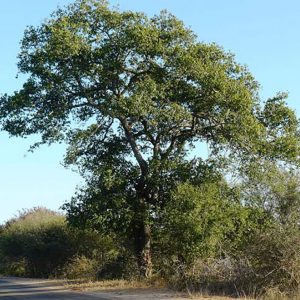
Brown ivory / Bruin ivoor
Brown ivory / Bruin ivoorAn attractive fast growing tree with a short trunk and rounded crown. The bark is grey-brown and the leaves are shiny dark green above and pale green below. Perfect for the garden to create shade and to attract birds.
Botanical Name:
Berchemia discolor
Did you know?
The fruits of brown-ivory are rich in Vitamin C!
Brown stinkwood / Bruin stinkhout (Mitserie)
Brown stinkwood / Bruin stinkhout (Mitserie)
Brown stinkwood / Bruin stinkhout (Mitserie)
Brown stinkwood / Bruin stinkhout (Mitserie)A perfect garden tree for those who want thick shade in the summer. The trunk is usually single with a rounded or dome-shaped crown and scattered bright red leaves. Mitzeeri’s are also a good tree if one wants to attract birds. In autumn to winter months the leaves turn a brilliant red or orange, making it an attractive tree all year round.
Botanical Name:
Bridelia micrantha
Did you know?
The roots are used to treat stomach complaints and leaf sap is used for sore eyes.
Bushveld gardenia / Bosveld katjiepiering
Bushveld gardenia / Bosveld katjiepiering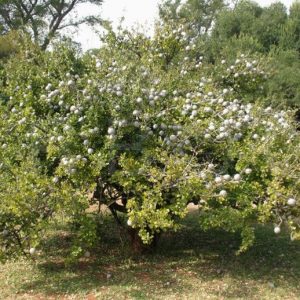
Bushveld gardenia / Bosveld katjiepiering
Bushveld gardenia / Bosveld katjiepieringA small, bushy tree – good to use for screening. The flowers are showy, solitary, large, white in colour and sweetly scented.
Botanical Name:
Gardenia volkensii
Did you know?
The gardenia volkensii is used medicinally as a cure for intestinal worms as well as infusions of the fruit and roots are used to induce vomiting.

Fevertree / Koorsboom
Fevertree / KoorsboomThe characteristic, almost luminous, lime green to greenish-yellowbark is smooth, slightly flaking, and coated in a yellow powdery substance described by some as sulphurous. The fever tree is an exceptionally attractive tree and is often used to decorate gardens and urban landscapes.
Botanical Name:
Vachellia xanthophloea
Forest bushwillow / Bosvaderlandswilg
Forest bushwillow / Bosvaderlandswilg
Forest bushwillow / Bosvaderlandswilg
Forest bushwillow / BosvaderlandswilgA handsome, quick growing and reasonably cold resistant tree that is recommended for shady areas in gardens with a mild to warm climate. The crown is rounded with dark green foliage, with reddish autumn colours and sometimes whitish spring flowers.
Botanical Name:
Combretum krausii
Did you know?
Combretums are pollinated by various kinds of insects, including bees. They have adapted to wind dispersal by developing a wing-like fruit structure that can carry the seed with the help of air currents or wind. Some animals are known to eat Combretum fruit and also help with the seed dispersal.
Jackalberry / Jakkalsbessie
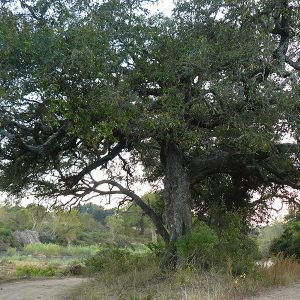
Jackalberry / JakkalsbessieA medium-sized tall, upright tree with a dense canopy. The bark is black to grey with a rough texture. They often grow on termite mounds.
Botanical Name:
Diospyros mespiliformis
Did you know?
The jackalberry has a fantastic mutualism and symbiotic network with many living organisms, from human beings to small insects. There is a complex ecological system revolving around this tree. It is one of the savanna giants that can live for more than 200 years.
Lavender tree / Laventel boom
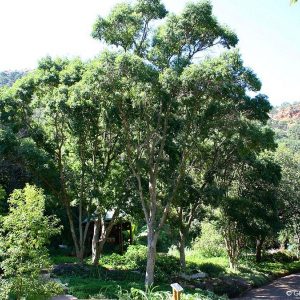
Lavender tree / Laventel boomHeteropyxis natalensis is an ideal tree for home gardens – a good focal point. It doesn’t get too big and the root system is non-invasive. The tree is usually multistemmed, the crown is rounded and foliage drooping.
Botanical Name:
Heteropyxis natalensis
Did you know?
A favourite of the black rhino and the leaves are used in potpourrie because of their signature scent.

Monkey thorn / Apiesdoring
Monkey thorn / ApiesdoringThis is a large tree with luxuriant, light green foliage. Its fast growth rate and attractive shape makes it ideal for a big garden, avenue or car park.
Botanical Name:
Senegalia galpinii
Did you know?
Many birds often prefer nesting in this tree as it provides protection.
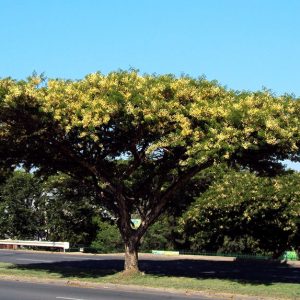
Paperbark / Papierbas
Paperbark / PapierbasPure stands of these beautifully shaped trees with their perfectly flattened crowns are quite stunning. Where else but in Africa would you encounter such a sight?
Botanical Name:
Vachellia sieberiana woodii
Did you know?
It is a favoured nesting tree for Barbets. The Green Wood Hoopoe love probing under the yellow, papery, flaking bark for insects.
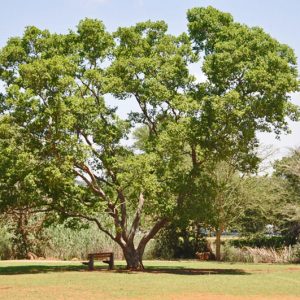
River bushwillow / Vaderlandswilg
River bushwillow / VaderlandswilgThe river bushwillow is often multi-stemmed and somewhat willow-like in habit. It boasts a beautiful form which is just as magical in autumn. Nowadays it is often grown as a street tree and also in gardens for ornament and shade.
Botanical Name:
Combretum erythrophyllum
Did you know?
Roots are used to treat venereal diseases and also as purgatives. Dried, powdered gum may be applied to sores.

Sausage tree / Worsboom
Sausage tree / WorsboomKigelia africana is also one of those significant trees in South Africa. Known for its large elongated fruit and showy flowers. Many animals feed on the flowers, fruit and leaves. The trunk is short, straight and relatively thick with a spreading and dome-shaped crown.
Botanical Name:
Kigelia africana
Did you know?
It is one of the first trees to flower in the Kruger Park in early spring.
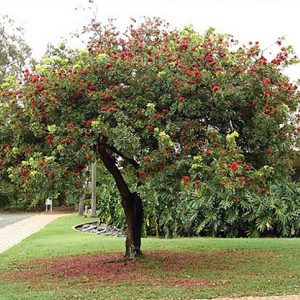
Weepingboerbean / Huilboerboon
Weepingboerbean / HuilboerboonA handsome tree with a wide-spreading, rounded crown, and bright red, nectar-filled flowers in spring and early summer that attract many birds and insects. It is easy to grow and makes a good shade tree or specimen tree.
Botanical Name:
Schotia brachypetala
Did you know?
Not only is Schotia brachypetala an exceptional ornamental tree, it also has a number of other uses: A decoction of the bark is taken to treat heartburn and hangovers.
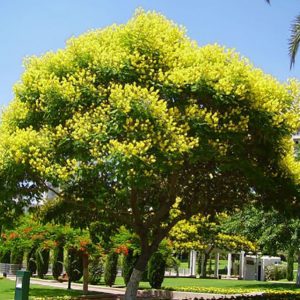
Weepingwattle / Huilboom
Weepingwattle / HuilboomThe weepingwattle has acacia-like foliage and showy yellow flowers. It’s an excellent tree for bee-keepers. It has a spreading untidy canopy and makes a good shade tree for both livestock and humans.
Botanical Name:
Peltohorum africanum
Did you know?
Young leaves and pods are eaten by livestock and the flowers provide a high yield of nectar and pollen for bee-keeping.

White karee / Wit karee
White karee / Wit kareeA perfect tree for the suburban garden! The Searsia pendulina is quick and easy to grow with a graceful habit and a neat crown, it won’t get too big and it’s not untidy.
Botanical Name:
Searsia pendulina
Did you know?
The berries of the white karee are mixed with Acacia karoo gum to make a sticky sweet that tastes a bit like dates.
