

Fevertree / Koorsboom

Fevertree / Koorsboom
The characteristic, almost luminous, lime green to greenish-yellowbark is smooth, slightly flaking, and coated in a yellow powdery substance described by some as sulphurous. The fever tree is an exceptionally attractive tree and is often used to decorate gardens and urban landscapes.
Botanical Name:
Vachellia xanthophloea
Related products
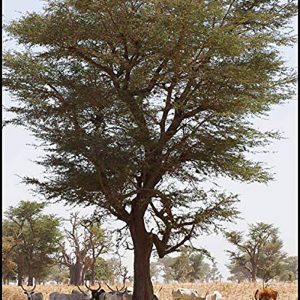
Anna tree / Anna boom
Anna tree / Anna boomA fast-growing tree with a greenish grey to whitish bark. The foliage is also green to grey in colour. Interestingly enough, the Anna tree loses its thorns when it matures into an adult tree – making it a good garden tree!
Botanical Name:
Faidherbia albeda
Did you know?
The pods are an important source of food to livestock and game in the ry season.
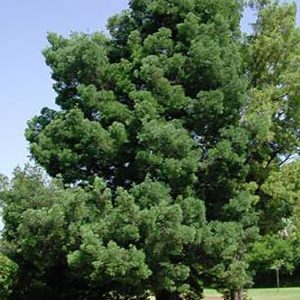
Outeniqua yellowwood / Geelhout
Outeniqua yellowwood / GeelhoutThis fast-growing, majestic yellowwood with its elegant shape is certainly a tree for all seasons and all gardens. It is an excellent container plant and can also be decorated and used as an indoor Christmas tree.
Botanical Name:
Podocarpus falcatus
Did you know?
Podocarpus falcatus could make an ideal indigenous substitute for the exotic pine trees currently being used in plantations. Trials done at a forest station at Magoebaskloof showed that the yield is similar, with the growth rate and quality of the wood comparing favourably to that of commercial pine.
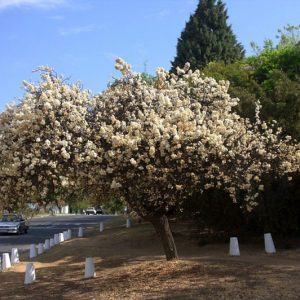
Wild pear / Drolpeer
Wild pear / DrolpeerThe wild pear is a lovely garden specimen, and the spectacular show of scented flowers is a herald of spring. It has a single stem and a somewhat rounded crown. It is both frost and drought resistant.
Botanical Name:
Dombeya rotundifolia
Did you know?
Strong rope can be made from the fibrous inner bark.
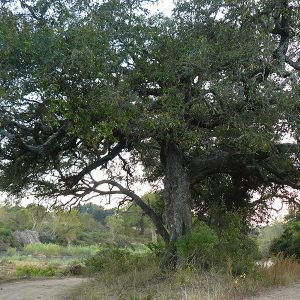
Jackalberry / Jakkalsbessie
Jackalberry / JakkalsbessieA medium-sized tall, upright tree with a dense canopy. The bark is black to grey with a rough texture. They often grow on termite mounds.
Botanical Name:
Diospyros mespiliformis
Did you know?
The jackalberry has a fantastic mutualism and symbiotic network with many living organisms, from human beings to small insects. There is a complex ecological system revolving around this tree. It is one of the savanna giants that can live for more than 200 years.
