

Weepingwattle / Huilboom

Weepingwattle / Huilboom
The weepingwattle has acacia-like foliage and showy yellow flowers. It’s an excellent tree for bee-keepers. It has a spreading untidy canopy and makes a good shade tree for both livestock and humans.
Botanical Name:
Peltohorum africanum
Did you know?
Young leaves and pods are eaten by livestock and the flowers provide a high yield of nectar and pollen for bee-keeping.
Related products
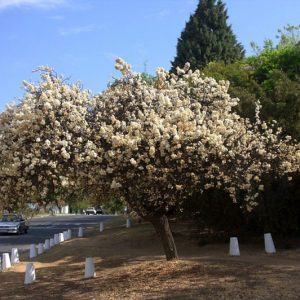
Wild pear / Drolpeer
Wild pear / DrolpeerThe wild pear is a lovely garden specimen, and the spectacular show of scented flowers is a herald of spring. It has a single stem and a somewhat rounded crown. It is both frost and drought resistant.
Botanical Name:
Dombeya rotundifolia
Did you know?
Strong rope can be made from the fibrous inner bark.

Tree wisteria /Vanwykshout
Tree wisteria /VanwykshoutOne of the most spectacular flowering trees – the tree wisteria is known for its clusters of bright purple flowers. It has an upright crown and drooping foliage. A very colourful ornamental and shade tree.
Botanical Name:
Bolusanthus speciosus
Did you know?
The wood is heavy, durable and suitable for fence posts, and furniture.

Toad tree / Padda boom
Toad tree / Padda boomA beautiful bushveld tree that can be recognised by its large, glossy leaves, fragrant white flowers and large fruit borne in pairs. With its unusual fruits it is excellent for gardeners wanting to bring nature back into their garden ? it attracts birds, insects and small mammals.
Botanical Name:
Tabernaemontana elegans
Did you know?
The seeds are burnt, grounded to a powder and mixed with tobacco for chewing or smoking by the Zulu people.
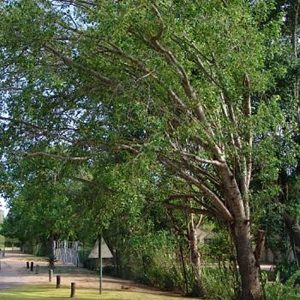
False marula / Vals maroela
False marula / Vals maroelaThis small to medium-sized tree with its small, creamy white to yellow flowers and aromatic leaves, will not only attract birds to your garden, but can be very successfully grown as a bonsai specimen. The trunk is straigh tand erect with a rounded or dome-shaped crown. The leaves are pale green with the tips abruptly but broadly tapering.
Botanical Name:
Lannea sweinfurthii
Did you know?
The false marula tree is economically important in South Africa. It is very successfully used to feed cattle and game. The cattle eat the fresh or dry leaves and this reduces the expenses on fodder by farmers who are growing these trees.
