

Wild olive / Wilde olyf

Wild olive / Wilde olyf
The wild olive is neatly shaped with grey-green to dark-green leaves above and greyish below. This tree is an asset on farms and game farms, especially in very dry areas because it is extremely hardy and is an excellent fodder tree.
Botanical Name:
Olea sub. Africana
Did you know?
The flowers attract a host of insects. The abundant supply of nectar makes it a good honey tree.
Related products

Tree wisteria /Vanwykshout
Tree wisteria /VanwykshoutOne of the most spectacular flowering trees – the tree wisteria is known for its clusters of bright purple flowers. It has an upright crown and drooping foliage. A very colourful ornamental and shade tree.
Botanical Name:
Bolusanthus speciosus
Did you know?
The wood is heavy, durable and suitable for fence posts, and furniture.
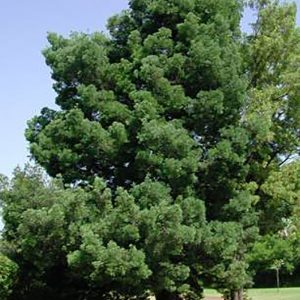
Outeniqua yellowwood / Geelhout
Outeniqua yellowwood / GeelhoutThis fast-growing, majestic yellowwood with its elegant shape is certainly a tree for all seasons and all gardens. It is an excellent container plant and can also be decorated and used as an indoor Christmas tree.
Botanical Name:
Podocarpus falcatus
Did you know?
Podocarpus falcatus could make an ideal indigenous substitute for the exotic pine trees currently being used in plantations. Trials done at a forest station at Magoebaskloof showed that the yield is similar, with the growth rate and quality of the wood comparing favourably to that of commercial pine.
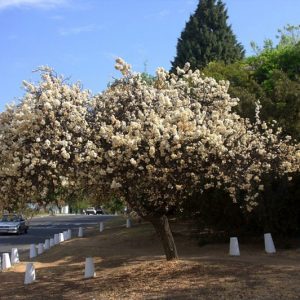
Wild pear / Drolpeer
Wild pear / DrolpeerThe wild pear is a lovely garden specimen, and the spectacular show of scented flowers is a herald of spring. It has a single stem and a somewhat rounded crown. It is both frost and drought resistant.
Botanical Name:
Dombeya rotundifolia
Did you know?
Strong rope can be made from the fibrous inner bark.
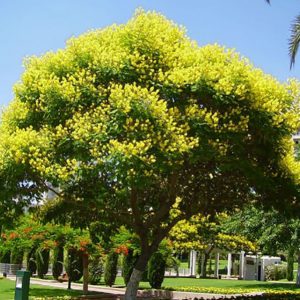
Weepingwattle / Huilboom
Weepingwattle / HuilboomThe weepingwattle has acacia-like foliage and showy yellow flowers. It’s an excellent tree for bee-keepers. It has a spreading untidy canopy and makes a good shade tree for both livestock and humans.
Botanical Name:
Peltohorum africanum
Did you know?
Young leaves and pods are eaten by livestock and the flowers provide a high yield of nectar and pollen for bee-keeping.
