

Tree wisteria /Vanwykshout

Tree wisteria /Vanwykshout
One of the most spectacular flowering trees – the tree wisteria is known for its clusters of bright purple flowers. It has an upright crown and drooping foliage. A very colourful ornamental and shade tree.
Botanical Name:
Bolusanthus speciosus
Did you know?
The wood is heavy, durable and suitable for fence posts, and furniture.
Related products

Marula / Maroela
Marula / MaroelaThe edible fruits and the multiple uses associated with almost all parts of the marula, make it one of southern Africa’s most valued trees.
Botanical Name:
Sclerocaraya birrea
Did you know?
The Marula is a firm favourite for elephants, who delight in the fruit and the nutritious bark. Luckliy an elephant would have to eat hundreds and hundreds of fermented marula fruits in order to ingest the same equivalent of alcohol as a few beers for a grown man.
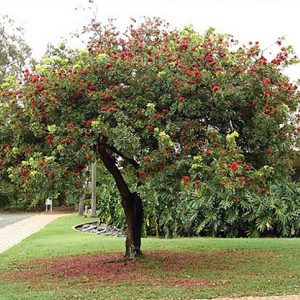
Weepingboerbean / Huilboerboon
Weepingboerbean / HuilboerboonA handsome tree with a wide-spreading, rounded crown, and bright red, nectar-filled flowers in spring and early summer that attract many birds and insects. It is easy to grow and makes a good shade tree or specimen tree.
Botanical Name:
Schotia brachypetala
Did you know?
Not only is Schotia brachypetala an exceptional ornamental tree, it also has a number of other uses: A decoction of the bark is taken to treat heartburn and hangovers.
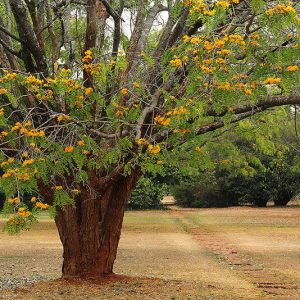
Wild mango / Wilde mango
Wild mango / Wilde mangoThis is a tall tree with a flat-topped, widespreading crown. The yellowish-orange flowers resemble an old fashioned powder puff. Elephants love the fruit!
Botanical Name:
Cordylia africana
Did you know?
Did you know that Africa has its own mango? Although the fruit is not as big and tasty as the exotic one and it belongs to a different family, it is extremely rich in vitamin C.
False buffalo thorn / Vals buffeldoring
False buffalo thorn / Vals buffeldoring
False buffalo thorn / Vals buffeldoring
False buffalo thorn / Vals buffeldoringA thornless, upright tree with dark green leaves. Flocks of birds are attracted by the yellow berries, which ripen at the end of summer. The tree can also be used as a windbreaker.
Botanical Name:
Ziziphus rivularis
Did you know?
Ziziphus mucronata, or as it is more frequently known, the wag-‘n-bietjie tree is said to represent life as we know it. The young twigs are zigzag, indicating that life is not always straightforward. Two thorns at the nodes are also significant; one facing backward represents where we come from and one facing forward, represents where we are going.
