

Natal guarii / Natal gwarrie

Natal guarii / Natal gwarrie
With its rounded crown and dark green foliage, the natalgwarrie is suited to an array of differnent types of gardens. The bushy, shrubby and small habitat tree is excellent for screening.
Botanical Name:
Euclea natalensis
Did you know?
It bears fruit which is edible and eaten by birds, monkeys and humans too! The twigs can be used as a toothbrush if needed.
Related products
Forest natal mahogany / Bosrooiesenhout
Forest natal mahogany / Bosrooiesenhout
Forest natal mahogany / Bosrooiesenhout
Forest natal mahogany / BosrooiesenhoutTrichilia dregeana is a lovely large tree that inhabits evergreen forests in high rainfall areas. It is a highly ornamental species with considerable cultural and ecological value to match.
Botanical Name:
Trichelia dregeana
Did you know?
The tree provides suitable nesting sites for a number of bird species.

Waterberry / Waterbessie
Waterberry / WaterbessieThis beautiful tree is home to many birds and insects. The leaves are elliptic to circular, bluish green on top and a paler green below.
Botanical Name:
Syzigium cordatum
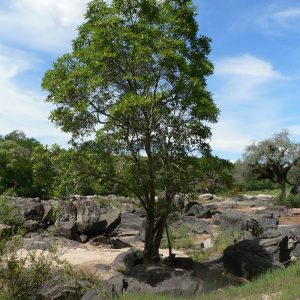
Matumi / Mingerhout
Matumi / MingerhoutA full grown matumi is something to behold! The trunk is tall and straight and the crown rather narrow. If in optimal conditions such as a warm climate and plenty of water a matumi will grow fairly quickly.
Botanical Name:
Breonadia salicina
Did you know?
Matumi’s twigs are used as toothbrushes in West Africa.
Forest bushwillow / Bosvaderlandswilg
Forest bushwillow / Bosvaderlandswilg
Forest bushwillow / Bosvaderlandswilg
Forest bushwillow / BosvaderlandswilgA handsome, quick growing and reasonably cold resistant tree that is recommended for shady areas in gardens with a mild to warm climate. The crown is rounded with dark green foliage, with reddish autumn colours and sometimes whitish spring flowers.
Botanical Name:
Combretum krausii
Did you know?
Combretums are pollinated by various kinds of insects, including bees. They have adapted to wind dispersal by developing a wing-like fruit structure that can carry the seed with the help of air currents or wind. Some animals are known to eat Combretum fruit and also help with the seed dispersal.
