

Wild mango / Wilde mango
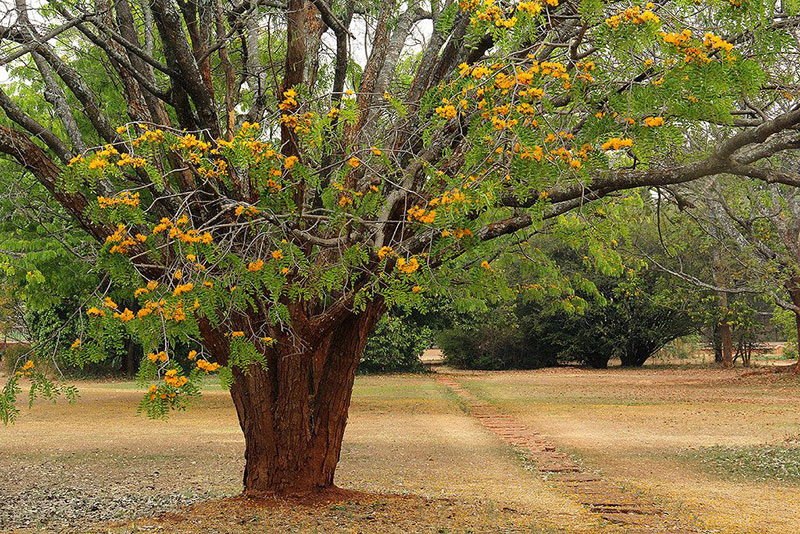
Wild mango / Wilde mango
This is a tall tree with a flat-topped, widespreading crown. The yellowish-orange flowers resemble an old fashioned powder puff. Elephants love the fruit!
Botanical Name:
Cordylia africana
Did you know?
Did you know that Africa has its own mango? Although the fruit is not as big and tasty as the exotic one and it belongs to a different family, it is extremely rich in vitamin C.
Related products

Marula / Maroela
Marula / MaroelaThe edible fruits and the multiple uses associated with almost all parts of the marula, make it one of southern Africa’s most valued trees.
Botanical Name:
Sclerocaraya birrea
Did you know?
The Marula is a firm favourite for elephants, who delight in the fruit and the nutritious bark. Luckliy an elephant would have to eat hundreds and hundreds of fermented marula fruits in order to ingest the same equivalent of alcohol as a few beers for a grown man.

Toad tree / Padda boom
Toad tree / Padda boomA beautiful bushveld tree that can be recognised by its large, glossy leaves, fragrant white flowers and large fruit borne in pairs. With its unusual fruits it is excellent for gardeners wanting to bring nature back into their garden ? it attracts birds, insects and small mammals.
Botanical Name:
Tabernaemontana elegans
Did you know?
The seeds are burnt, grounded to a powder and mixed with tobacco for chewing or smoking by the Zulu people.
Henkel’s yellow / Henkel-se-Geelhout
Henkel’s yellow / Henkel-se-Geelhout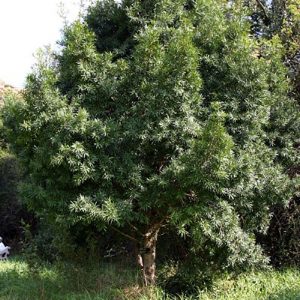
Henkel’s yellow / Henkel-se-Geelhout
Henkel’s yellow / Henkel-se-GeelhoutPodocarpus henkelii is a very neat decorative tree suitable for both home gardens and large landscapes. It makes and excellent specimen tree for lawns and is a good choice for an avenue. Podocarpus henkelii is also suited for formal gardens, as it can be pruned to the desired shape. It can also be left to achieve an informal finish.
Botanical Name:
Podocarpus henkelii
Did you know?
As a nesting site, the trees, especially older, large specimens, are favoured by many birds.
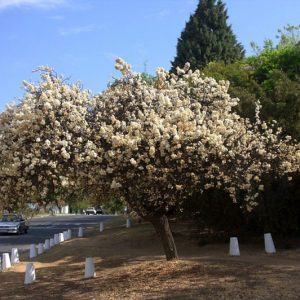
Wild pear / Drolpeer
Wild pear / DrolpeerThe wild pear is a lovely garden specimen, and the spectacular show of scented flowers is a herald of spring. It has a single stem and a somewhat rounded crown. It is both frost and drought resistant.
Botanical Name:
Dombeya rotundifolia
Did you know?
Strong rope can be made from the fibrous inner bark.
