

Brown ivory / Bruin ivoor

Brown ivory / Bruin ivoor
An attractive fast growing tree with a short trunk and rounded crown. The bark is grey-brown and the leaves are shiny dark green above and pale green below. Perfect for the garden to create shade and to attract birds.
Botanical Name:
Berchemia discolor
Did you know?
The fruits of brown-ivory are rich in Vitamin C!
Related products

Apple leaf / Appelblaar
Apple leaf / AppelblaarThe Apple leaf is a medium- to large-sized tree with a wide-spreading, dense and rounded crown. The main stem is tall, straight and bare, occasionally bent and twisted.
Botanical Name:
Philenoptera violacea
Did you know?
The wood of this attractive tree makes a stunning ornamental display.
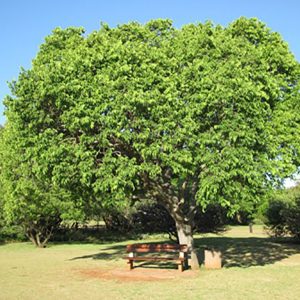
White stinkwood / Wit stinkhout
White stinkwood / Wit stinkhoutAn ideal garden tree – the white stinkwood usually has a single trunk and broadly upright to rounded crown. When planted on the northern or western side of the house, the shade provided cools the house in summer yet allows the sun through to heat up the house in winter.
Botanical Name:
Celtis africana
Did you know?
When freshy cut, the wood has an unpleasant smell, hence the common names “stinkwood”.
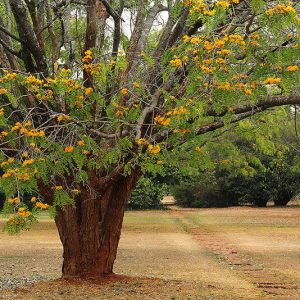
Wild mango / Wilde mango
Wild mango / Wilde mangoThis is a tall tree with a flat-topped, widespreading crown. The yellowish-orange flowers resemble an old fashioned powder puff. Elephants love the fruit!
Botanical Name:
Cordylia africana
Did you know?
Did you know that Africa has its own mango? Although the fruit is not as big and tasty as the exotic one and it belongs to a different family, it is extremely rich in vitamin C.

Coral tree / Koraal
Coral tree / KoraalA medium-sized tree with beautiful deep orange to scarlet colour flowers and a spreading, rounded crown. It is not just a decorative tree, it also provides food for a whole host of animals. The tree flowers in winter when animals need food the most.
Botanical Name:
Erythrina lysistemon
Did you know?
Also known by many as the “Lucky bean” tree due to its beautiful red seeds.
