

Marula / Maroela
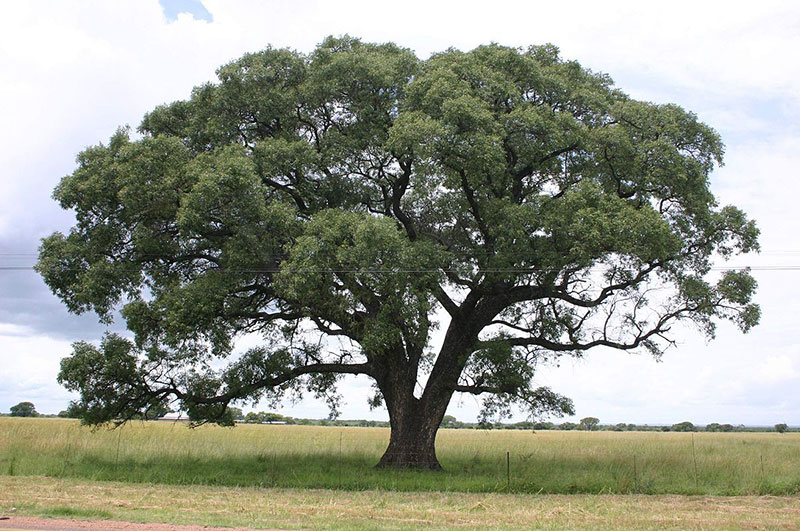
Marula / Maroela
The edible fruits and the multiple uses associated with almost all parts of the marula, make it one of southern Africa’s most valued trees.
Botanical Name:
Sclerocaraya birrea
Did you know?
The Marula is a firm favourite for elephants, who delight in the fruit and the nutritious bark. Luckliy an elephant would have to eat hundreds and hundreds of fermented marula fruits in order to ingest the same equivalent of alcohol as a few beers for a grown man.
Related products
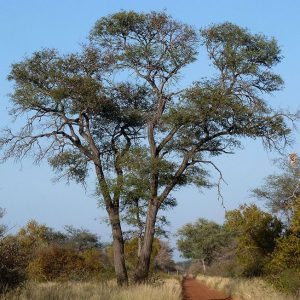
Knob thorn / Knoppiesdoring
Knob thorn / KnoppiesdoringThe knob thorn is an attractive garden tree which grows into a lovely shade tree. It has a long cylindrical shape and rounded crown. It has knobs on the trunks and on branches with persistent thorns arising on the knobs.
Botanical Name:
Senegalia nigrescens
Did you know?
The knob thorn is termite-resistant and the flowers are a dietary component for giraffes.
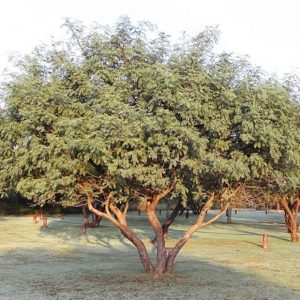
Hook-thorn / Haakdoring
Hook-thorn / HaakdoringThis beautiful tree is the most common naturally occurring senegalia in the Witwatersrand National Botanical Garden. It has an irregular, spreading crown. One of the most attractive features of the tree is the foliage which is bright green and feathery looking. The leaves are drooping which gives the canopy a lovely soft look.
Botanical Name:
Senegalia caffra
Did you know?
The common hook-thorn is used traditionally for many purposes such as fencing posts, tanning and the beautiful rootwood is highly valued by Xhosa women for tobacco pipes.
False buffalo thorn / Vals buffeldoring
False buffalo thorn / Vals buffeldoring
False buffalo thorn / Vals buffeldoring
False buffalo thorn / Vals buffeldoringA thornless, upright tree with dark green leaves. Flocks of birds are attracted by the yellow berries, which ripen at the end of summer. The tree can also be used as a windbreaker.
Botanical Name:
Ziziphus rivularis
Did you know?
Ziziphus mucronata, or as it is more frequently known, the wag-‘n-bietjie tree is said to represent life as we know it. The young twigs are zigzag, indicating that life is not always straightforward. Two thorns at the nodes are also significant; one facing backward represents where we come from and one facing forward, represents where we are going.
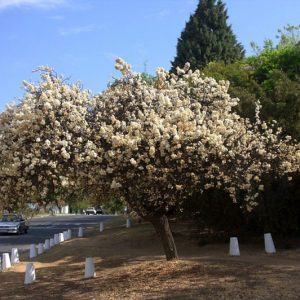
Wild pear / Drolpeer
Wild pear / DrolpeerThe wild pear is a lovely garden specimen, and the spectacular show of scented flowers is a herald of spring. It has a single stem and a somewhat rounded crown. It is both frost and drought resistant.
Botanical Name:
Dombeya rotundifolia
Did you know?
Strong rope can be made from the fibrous inner bark.
