

Broomcluster fig / Besemtrosvy

Broomcluster fig / Besemtrosvy
This tree boasts a massive spreading crown. The figs are born in large clusters on the stem of the tree and very often low down close to the ground. Like most figs, it can be found along rivers and other water sources. It provides food for a lot of animals.
Botanical Name:
Ficus sur
Did you know?
Fig jam can be made from the fruits!
Related products
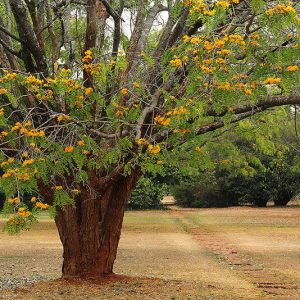
Wild mango / Wilde mango
Wild mango / Wilde mangoThis is a tall tree with a flat-topped, widespreading crown. The yellowish-orange flowers resemble an old fashioned powder puff. Elephants love the fruit!
Botanical Name:
Cordylia africana
Did you know?
Did you know that Africa has its own mango? Although the fruit is not as big and tasty as the exotic one and it belongs to a different family, it is extremely rich in vitamin C.
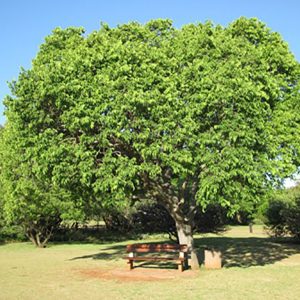
White stinkwood / Wit stinkhout
White stinkwood / Wit stinkhoutAn ideal garden tree – the white stinkwood usually has a single trunk and broadly upright to rounded crown. When planted on the northern or western side of the house, the shade provided cools the house in summer yet allows the sun through to heat up the house in winter.
Botanical Name:
Celtis africana
Did you know?
When freshy cut, the wood has an unpleasant smell, hence the common names “stinkwood”.
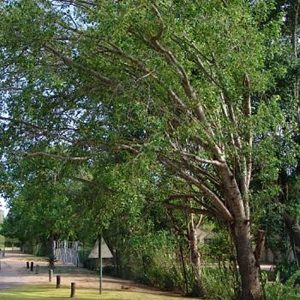
False marula / Vals maroela
False marula / Vals maroelaThis small to medium-sized tree with its small, creamy white to yellow flowers and aromatic leaves, will not only attract birds to your garden, but can be very successfully grown as a bonsai specimen. The trunk is straigh tand erect with a rounded or dome-shaped crown. The leaves are pale green with the tips abruptly but broadly tapering.
Botanical Name:
Lannea sweinfurthii
Did you know?
The false marula tree is economically important in South Africa. It is very successfully used to feed cattle and game. The cattle eat the fresh or dry leaves and this reduces the expenses on fodder by farmers who are growing these trees.

Knobbly fig / Knoppiesvy
Knobbly fig / KnoppiesvyJust like many of the fig species, the knobbly fig feeds a variety of animals and has a beautiful growth form. It may grow as an ordinary, stand-alone tree or in a cluster.
Botanical Name:
Ficus sansibarika
Did you know?
The leaves are browsed by elephants, giraffe, kudu and nyala.
