

Baobab / Kremetart

Baobab / Kremetart
This large tree is probably one of Africa’s most symbolic trees. The baobab is well known throughout the world for its unique form and often gigantic proportions.
Botanical Name:
Adansonia digitata
Did you know?
The baobab is regarded as the largest succulent plant in the world.
Related products
Buffalo thorn / Blikblaar wag-n-bietjie
Buffalo thorn / Blikblaar wag-n-bietjie
Buffalo thorn / Blikblaar wag-n-bietjie
Buffalo thorn / Blikblaar wag-n-bietjieit makes a pleasant shade tree and gives life to the garden by luring birds and insects such as butterflies, beetles and bees. In Botswana as well as most parts of South Africa, the residents believed the buffalo thorn to be immune against lightning, anyone standing under one in a storm would be safe. It is also believed that if it is felled in summer, a drought, hail or lightning will certainly follow.
Botanical Name:
Ziziphus mucronata
Did you know?
Ziziphus mucronata, or as it is more frequently known, the wag-‘n-bietjie tree is said to represent life as we know it. The young twigs are zigzag, indicating that life is not always straightforward. Two thorns at the nodes are also significant; one facing backward represents where we come from and one facing forward, represents where we are going.
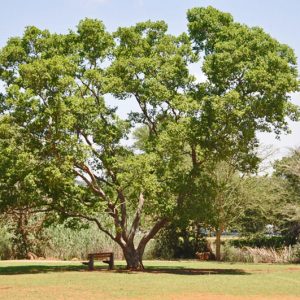
River bushwillow / Vaderlandswilg
River bushwillow / VaderlandswilgThe river bushwillow is often multi-stemmed and somewhat willow-like in habit. It boasts a beautiful form which is just as magical in autumn. Nowadays it is often grown as a street tree and also in gardens for ornament and shade.
Botanical Name:
Combretum erythrophyllum
Did you know?
Roots are used to treat venereal diseases and also as purgatives. Dried, powdered gum may be applied to sores.
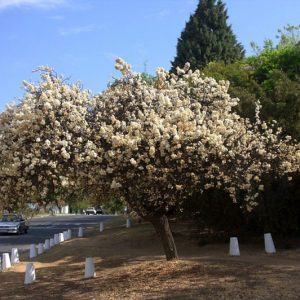
Wild pear / Drolpeer
Wild pear / DrolpeerThe wild pear is a lovely garden specimen, and the spectacular show of scented flowers is a herald of spring. It has a single stem and a somewhat rounded crown. It is both frost and drought resistant.
Botanical Name:
Dombeya rotundifolia
Did you know?
Strong rope can be made from the fibrous inner bark.

Snuffbox tree / Snuifkalbassie
Snuffbox tree / SnuifkalbassieThis spiny shrub or small tree with pretty white flowers is known for the snuff boxes that can be made from its hard-shelled fruit. An ideal barrier plant.
Botanical Name:
Oncoba spinosa
Did you know?
Flowers somewhat resemble a fried egg and in Zimbabwe it is called the fried-egg flower.
